An enterprise doesn't run on one database. It runs on dozens of external partners — one sends the email, one keeps the sales data, one analyses the images, one runs the AI workflows, one aggregates the big data — plus its own databases, APIs and infrastructure. Day to day, that is dozens of consoles, dozens of credentials, and a crontab of polling scripts written by people who have since left. There is no single fabric. There are threads — and right now, you are the loom.
Vantage wires it all into one internal, live data mesh. The mesh is defined declaratively, and Vantage UI is where you see it and shape it — your AI agent making the changes while the result runs in front of your eyes. The mesh carries writes, actions and scripts, so the fabric you monitor is the same fabric you operate.
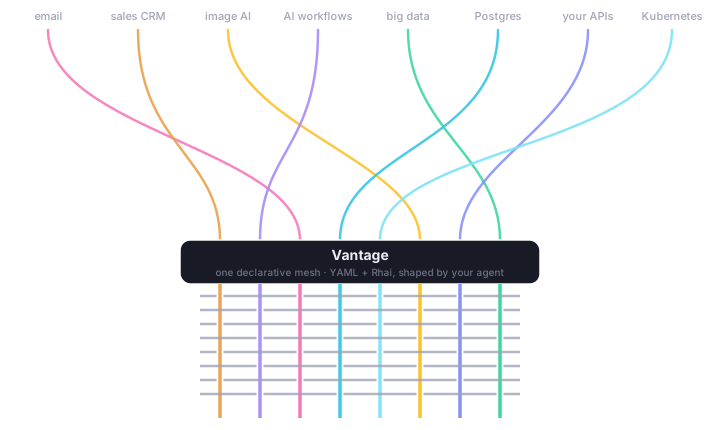
Vantage doesn't try to control everything — it gives you the tools to build your own thing, free forever under MIT.
Declare once, serve it three ways🔗
What you declare in Vantage is a definition — and one definition has three ways out:
Full type safety, real-time or transactional, built for multi-threaded apps — as open-source crates your services link directly.
Roll the same definition into a REST API — poll, live-push or websocket, chosen per consumer. Detailed below.
Drop it into your cloud or mobile apps: a high-frequency cache that knows your business logic, running right beside the code that needs it.
The facade API, up close🔗
Your web and mobile apps are only as fast as the network between them and your backend. Every screen round-trips a database that's hundreds of milliseconds away, so lists arrive with a spinner, data goes stale the moment it lands, and every team ends up rebuilding the same caching, retry and state-sync plumbing by hand.
A Vantage facade API sits in front of your data — a small service you deploy close to your users that keeps a live local copy, answers reads instantly from it, and streams every change back into your app as it happens. Your frontend stops polling a distant REST tier and starts reading a cache that reacts.
Your web & mobile app
unchanged frontend — it renders from a cache and watches for changesVantage facade API
live cache · reactive views · deployed at the edge, close to your usersYour data & partners
SQL · SurrealDB · MongoDB · REST · GraphQL — however far awayThe facade is a plain Rust service, so you run it wherever your users are — one per region, at the edge — while your database of record stays put. The distant round-trip happens once, in the background; your app talks to something milliseconds away.
What your frontend gets🔗
The screen paints from the local cache the moment it opens — no waiting on the backend for the first frame.
Every open view holds a watch connection; when data changes, the update arrives on its own — no polling loop to write.
The facade fetches details for the rows the user is actually looking at, so a million-row list stays cheap.
Inside the facade: a scenery🔗
The facade isn't a framework you configure — it's a handful of lines of Rust. A scenery is a standing live view onto the cache: open it, read it, subscribe to it. The same interface drives a desktop grid, a terminal, and this facade:
// The same declaration your console runs — now inside your service.
// `lens` holds the live cache; `orders` is a table from your mesh.
let dio = lens.make_dio(orders);
let scenery = dio.table_scenery().open().await?;
// Read it now, straight from the live cache…
let row = scenery.row(0);
// …and react when anything changes, from any source.
let mut changes = scenery.subscribe();
while changes.changed().await.is_ok() {
push_to_clients(&scenery);   // one update per burst of changes
}
On the wire, and in the frontend🔗
The facade answers a plain GET with a snapshot from the cache, and the same URL with ?watch=true keeps the connection open and streams changes as Kubernetes-style NDJSON — one line per change:
{"type":"ADDED",   "object":{"index":3,"filename":"…","rows":null,  "latest":null}}
{"type":"MODIFIED","object":{"index":3,"filename":"…","rows":143676,"latest":"20260531"}}
The frontend reads that stream straight off fetch — no client library, and the rows fill themselves in:
const res = await fetch(`/api/files?offset=${offset}&limit=${LIMIT}&watch=true`)
const reader = res.body.getReader()
// …split the stream on '\n'…
const event = JSON.parse(line)
setRows(rs => ({ ...rs, [event.object.index]: event.object }))
Putting together a React web app is a simple matter — you can vibe-code it. What's crucial is the plumbing underneath: two-way communication, conflict resolution, horizontal scaling. That's what Vantage solves.
A gradual path, not a rewrite🔗
You don't cut over all at once. Stand a facade up in front of the databases you already have, move one screen onto it, and let the rest keep hitting the old backend. Migrate at your pace, then delete the legacy tier behind it — no risky big-bang.
The facade is backend-agnostic. Move it — complex queries and all — with near-zero code change; your clients never notice.
Prototype over a CSV file, graduate to SQL, ship behind an API — the screens and the queries stay the same.
Modern Rust that runs on your own infrastructure — fully open-source and forever in your control.
- Query builder
- ORM
- Active Record
- Entity modeling
constructionThe framework — the live cache, the reactive views and the watch adapter — ships on crates.io today; you can build the facade now, and the guide below walks through it. Generating and hosting these facades for you as a managed service, and managing API routes from inside Vantage UI, are on the roadmap.
Start here🔗
arrow_forwardNext rung: rolling this out across an organisation — custom builds, training, partnership. Vantage for your organisation →